I love seeing this, what a great way to bring fresh produce into the inner city.
I’ve met a lot of people that are trying to take back their communities. Each year we give away produce from our garden to those in need, it’s a great feeling and it provides them with fresh chemical free produce. Depending on where you live, you might not have fresh produce available.
Occasionally I scout out grocery stores to see what they have on the shelves, I’ve noticed that in some stores fresh produce isn’t readily available.
Being an art lover you know I checked out the embroidery on one of his sleeves and the back of his denim jacket, love it! If you blink, you’ll miss it… 😉 I’m thinking this was a custom made jean jacket. You see the threads hanging from the jacket. Which makes me wonder, why in the world did the person leave those threads?
I find it fascinating to view beekeeping practices throughout the world
The above video is a clip about Kenyan beekeepers.
Facing angry bees: Bravery makes the man…
A few weeks ago, I received an email from a reader wondering if there were any “Black beekeepers”. Perhaps they thought to ask me since I’m obviously not “White.” Also, I have been talking about acquiring my own bees? Well, I don’t know all the “Black folks” on the planet, but I was able to tell my reader that my father and others in his neighborhood collected wild honey from a tree located in the nearby woods. Additionally as a child, he knew someone who kept bees, and yes they were Black.
That email brought about an interesting discussion between us, they chatted about the low representation of minorities and beekeeping here in the USA. I know there are “Black beekeepers” and other minorities out there, but I have no idea how large that group would be.
I can speculate that some of them are put off by the beekeeping literature that shows pictures of a predominately White/Caucasian community, and chose to forgo beekeeping events. Also, not everyone likes attending those sorts of things. I’m used to standing out in the crowd and don’t hesitate to attend any event that interests me regardless if I’m the only one of my race being represented. Sometimes I wonder how many others are willing to attend events where they might be in the minority?
Earlier this morning, I received the official confirmation of my honeybee purchase. I’d received the automated response after placing my order, so it was nice to hear directly from the beekeeper letting me know that they’d contact me when my bee packages were ready to be shipped.
I’m excited about my honeybees but there’s a hint of nervousness too. It’s a new venture after all, and I’m bound to make some mistakes but I realize that’s fine. Part of my apprehension is that many of my views about “bee management” isn’t what’s normally taught in beekeeping circles.
I pretty much want to let the honeybees do their thing, without too much intervention from myself. Normally that doesn’t bother me, since I really don’t care what people think when I’ve made up my mind. However since I’m “new” to beekeeping I do feel at a slight disadvantage since I have no experience as a beekeeper. As a child, one of my favorite gifts that I received was a book on bees. My parents knew about my love of bees, and provided me with a book on that topic. I still have that book. Throughout the years, my love for bees have increased. However reading, is still not the same thing as being a beekeeper. I’m sure, as I progress with beekeeping some of my views will change, but I honestly don’t think I’ll ever medicate my honeybees. Also, I’m positive my focus won’t be honey production. It’s not why I’m finally getting my bees.
Do we really need to use chemicals to treat honeybees?
Several years ago, I learned about the treatments used on honeybees and I questioned the medications used to eliminate parasites. After all honeybees are insects. I can’t help but think that treating the unwanted bugs with a variety of chemicals might have a negative impact on the honeybees. So years before I planned on acquiring bees, I knew that I needed to look for alternative methods.
Part of my research involved venturing online and looking for others that questioned the traditional methods used with honeybees. A few years ago, I stumbled upon Craig Yerdon’s, Organically Managed Beekeeping site. I enjoyed his videos and was disappointed when he went silent. I’m hoping he starts his podcasts again, since I found them incredibly informative.It cleared up some of the cobwebs I had about beekeeping. He’s local! If he ever offers a course at his place I’d definitely make the trek to take his class.
Michael Bush: Treatment free beekeeping
Organic Beekeepers is another online discovery. It’s a wonderful yahoo group that I stumbled upon about three or four years ago. I believe the host is Dee Lusby, who also practices treatment free beekeeping. Michael Bush, another treatment-free, beekeeper is also part of this awesome yahoo group. I’m thrilled that there are options available for those who want to try treatment-free beekeeping.
I do wish that I could find a local beekeeping group that used the treatment-free approach. I’m hoping that a few members of the Central Maryland Beekeeper’s Association, incorporate this method with their own hives.
I saw the design, Stitchy Bunny, at the Urban Threads website. I thought it was really cute. I swapped the colors used in the featured sample and sewed the embroidered design you see above.
This is Urban Threads “Stitchy Bunny”. I didn’t embroider this, it’s the sample that is featured on their site.
My daughter thought the above sample was “creepy.” I liked it, but she was happy with the color changes I made to the embroidered design.
She’s excited that is finally warm here in Maryland since she can now wear the t-shirt as a regular shirt. I’m really enjoying my Brother SE400, my daughter hopes I outgrow the machine. It can only embroider in a 4×4 area, because I told her if I upgrade I’ll give that Brother sewing/embroidery machine to her.
Yesterday was a busy day, for this soon to be beekeeper.
I exchanged several emails with the president of Central Maryland Beekeepers Association, Roger Williams. He did such a great job of taking the time to answer my questions in long/detailed emails that by the time I chatted with one of the potential mentors that agreed to help newbies, I didn’t have too many questions left to ask! However, my bee mentor did a wonderful job giving me some helpful information and clearing up some of my anxiety about purchasing hives. Thanks so much you two! Thanks to Garden Diaries, my local bee mentor, I’ve decided to go with one of the preassembled Langstroth hive. I’ll purchase it from a local beekeeper.
Yesterday my daughter, our dog, and I spent most of our day outside. The weather was gorgeous. Which made perfect weather for playing and strolling around our property.
Part of our tilled garden
I checked on the recently tilled garden
Collard plants
And was happy to see that the collards are coming along nicely.
A few of our strawberry plants
We also have a row of strawberry plants. The thing about strawberries is you have to pick them as soon as they start turning pink. If you wait the birds will eat them.
Our Shih Tzu: Mr. Bentley
And then Mr. Bentley and I made a trek near our woods to check out the area where I’ll be putting the beehives. My daughter was too engrossed in her blacktop chalk art to join our adventure.
Adding more honeybee friendly plants
I still have a lot of planting to do, and later this week I’ll be heading back to the nursery to purchase more bee friendly plants. I know that bees can travel long distance looking for nectar, but if I can… I’ll reduce some of their travel time by making some of their favorite plants readily available in our yard. I don’t have to purchase too many plants, since our yard is already bee-friendly. I adore bees and over the years, I’ve added numerous plants to attract them to our location. Did you know that honeybees make several trips to the hive each day since they can’t carry all that nectar/pollen in one trip?
I’ve already planted bee friendly wild flowers close to the woods and I’m planning to plant additional flowers close to the hives. There’s a water source close by the hive so they won’t have far to go to get their drink of water.
Enticing the honeybees; discouraging pests
I’ve decided at the base of the beehive(s) I most likely will sprinkle the area with diatomaceous earth to discourage ants from trying to visit the hive. Or I might just use cinnamon, since I know ants detest the stuff. We have large and small ants in our area. I adore ants, but I don’t want them to take over the beehive so I need to be proactive. Also, to make the new hive more “honeybee friendly” I’m also thinking of spraying the hive with lemongrass essential oil, honeybees love the smell and perhaps that will help in making their new hive feel like “home”. One of the benefits of being an aromatherapist is that I have plenty of essential oils on hand that can be used for numerous things.
Holistic approach to beekeeping
Additionally, this season I’ll be experimenting with various aromatherapy blends to deter the various pests that can plague honeybees. Although not the same thing, I’ve used a variety of herbs/aromatherapy blends on our furbabies and various critters that inhabit our yard with much success.
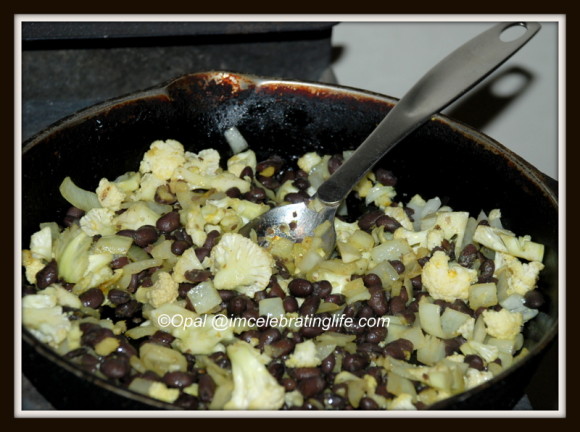
Yesterday, I made a simple but tasty black bean vegetable stir fry on our wood stove.
Black Bean stir fry
I pulled out my cast iron skillet. It’s about as old as my hand hammered stainless steel wok. This skillet is over twenty years old. I’ve had it since college. Besides black beans, I added other ingredients such as garlic, red onion, ginger, cauliflower, carrots, tomatoes, and other ingredients such as tomatoes. My daughter ate two bowls and asked for me to make it again today.
I dislike canned beans. When I cook my dried beans, I tend to make a large batch and use throughout the week. This past Thursday, I’d prepared these dried black beans on our wood stove. I cook my dried beans in large batches, and freeze into meal sized portions which are then consumed throughout the week.